


Founders write culture decks. But culture is set by who you actually hire in the first year — and the early compromises you make under pressure echo for a decade.
There's a slide most founders make somewhere around hire fifteen. It has four values on it, maybe five — words like ownership, candor, craft, urgency. It gets a nice typeface and a spot in the onboarding deck. The founder believes it. The team nods along.
And it describes almost nothing about how the company actually behaves, because the culture was already set. It was set by the seven people hired before the slide existed, in rooms with no values on the wall, under deadline pressure, by a founder who needed a body in a seat by Monday.
Culture is not the document. It's the behavior the document is trying to describe after the fact. And by the time you're writing it down, the behavior has already been chosen for you — by who you let in early.
Culture is behavior, not a deck
Ask a team what their company values and they'll recite the slide. Watch what actually gets rewarded and you'll learn the real values, which are frequently the opposite. The deck says candor; the room goes quiet when the founder is wrong. The deck says ownership; the fastest path to praise is looking busy. People are excellent at reading the gap between what's printed and what's practiced, and they calibrate to the practice every time.
So the question isn't what you wrote down. It's what your early employees actually do when no one's enforcing anything — how they treat a junior teammate, whether they cut a corner under pressure, what they say about a customer who isn't in the room. Those defaults become the company's defaults, because in a ten-person company there's nowhere for a behavior to hide.
Why the first ten are disproportionate
Every hire after the early cohort gets pattern-matched against the people already there. New employees don't read the handbook to learn how things work; they watch the person next to them and copy. That person was hired in year one. Their habits — good and bad — are now the template, replicated through every onboarding, every "this is how we do it here," every quiet correction of the newcomer who does it differently.
This is why the first ten hires carry weight the fiftieth never will. The fiftieth joins a culture that already exists and bends to it. The seventh is the culture, and everyone who follows is, in part, a copy of a copy of them. Get the early ones right and quality compounds. Get them wrong and the wrong thing compounds just as efficiently.
Visual 1 — Two kinds of culture
Dimension | Values-deck culture | Who-you-hired culture |
|---|---|---|
Where it lives | A slide in the onboarding deck | The desk next to the new hire |
How it spreads | Read once, then forgotten | Copied daily, then permanent |
What it rewards | What you said matters | What actually got someone praised |
Who sets it | The founder, aspirationally | Hires three through ten, in practice |
When it locks | Never, officially | Year one, quietly |
The right-hand column wins. When the printed values and the lived behavior disagree, employees follow the behavior — and the behavior was set by the people you hired before you ever wrote a value down.
The speed-versus-fit pressure
Knowing all this rarely helps in the moment, because the moment is brutal. You're three weeks behind on the roadmap, the one engineer who understood the billing system just gave notice, and there's a candidate who can start immediately and is clearly competent. They're a little abrasive in the interview. They talk over people. But you need the seat filled, and fit is a luxury you'll fix later.
You won't fix it later. The compromise hire doesn't stay contained to the gap they filled. They become a peer, then a model, then — if they're good at the job — a leader, and the abrasiveness you noticed in the interview is now encoded in how a third of the company runs meetings. The pressure that produced the hire is temporary. The hire is not.
The toxic star trap
Here's the part that runs against instinct. The most dangerous early hire is not the mediocre one with bad habits. It's the brilliant one with bad habits — and the more brilliant, the more dangerous.
A weak employee who behaves badly is easy to remove; nobody mourns them, and their behavior carries no authority. But a star who behaves badly makes the behavior aspirational. When the best engineer in the building is also the one who belittles people in code review, the team doesn't conclude that belittling is bad. It concludes that belittling is what excellence looks like. The behavior gets coupled to the success, and ambitious juniors adopt the whole package because they want the success and can't tell which part produced it.
A mediocre hire with bad behavior is a liability you can fire. A brilliant one is a liability you'll be tempted to promote — and every promotion teaches the room that the behavior is the price of admission.
This is the hire founders protect the longest and regret the most. The output is real, the dependency is real, and removing them feels like self-sabotage. By the time the cost becomes undeniable — the resignations of quieter, better-behaved people who simply left — the pattern is already three layers deep in the org.
What to screen for early
The early-stage interview over-indexes on capability because capability is easy to test and the work is urgent. But capability is the thing you can most afford to be flexible on in the first ten, because almost everyone you hire early will be stretched beyond their résumé anyway. What you cannot fix later is how someone behaves when they're stressed, wrong, or unsupervised — and that's precisely what most early interviews never probe.
Screen for how a candidate talks about former colleagues, because that's how they'll talk about yours. Watch how they treat the recruiter and the receptionist, not just the founder. Put them in a moment of disagreement and see whether they get curious or get defensive. You're not hiring a skill set for this year. You're choosing a template the next forty people will be measured against.
Visual 2 — How early hires propagate
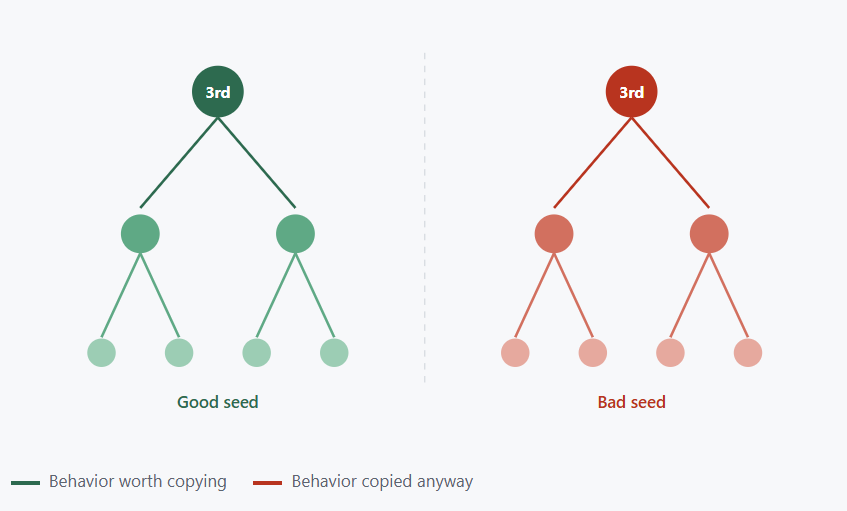
Conceptual model. Each early hire is a seed node. The org pattern-matches new people against it and replicates what it finds — and replication doesn't care whether the original was good or bad. Both trees grow at the same speed.
The cost of one wrong hire versus a slow seat
Founders consistently misprice this trade. An empty seat costs you visibly — work that doesn't get done, a deadline that slips. A wrong early hire costs you invisibly, and far more: the people who quietly leave because of them, the behaviors that calcify, the standard that resets one notch lower for everyone who follows. The open seat is a line item. The wrong hire is a tax on every future hire, paid forever.
A seat held open three extra months is recoverable. A culture bent in month four is not — at least not without the kind of surgery most founders won't perform until it's far too late.
What this means for founders
Hire the first ten like you're choosing a template, because you are. Each of these people will be copied — their habits, their defaults, their way of handling a bad day — by everyone who joins after. You're not filling a role. You're writing the behavior the next forty hires will pattern-match against without ever being told to.
Be most suspicious of your most impressive early candidate. Brilliance with bad behavior is the trap, because it makes the behavior look like the secret. If your best early hire is also your worst-behaved, you don't have a star. You have a teacher, and the lesson is one you don't want the room to learn.
Price the open seat honestly against the wrong fill. The empty chair hurts now and visibly; the wrong hire hurts later and quietly, and the later cost is larger every time. When the pressure says hire fast, that pressure is temporary. Whoever you let in to relieve it is not.
The deck can come later, and it should. But understand what it actually is: not the source of your culture, just a transcript of decisions you already made in a hurry. The values were set the day you filled the third seat. Write them down if you like — but hire as if the document doesn't exist, because for the people watching, it doesn't.
A LookatBusiness original. The hiring situations described are composite scenarios assembled from common early-stage patterns and do not depict any specific company or individual.