


Founders stress-test the market, the model, and the tech. The one risk most likely to kill the company is the one they treat as too awkward to examine — the relationship holding it together.
Two founders I'll call Dev and Priya had the kind of partnership investors love to back: complementary skills, real chemistry, a decade of friendship. They pressure-tested everything — the market size, the pricing, the technical risk, the competitive set. The one thing they never tested was the thing that ended the company. Eighteen months in, it turned out Dev wanted to build something durable and independent while Priya wanted a fast exit, and neither had ever said it out loud. The market didn't kill them. The unspoken gap between them did.
This is the most common way good startups die, and the least discussed. Product risk gets a slide. Market risk gets a slide. The co-founder relationship — statistically one of the largest controllable risks to the whole enterprise — gets a toast and an assumption. I call it the Co-Founder Fault Line: the seam of unexamined assumptions running underneath the partnership, invisible while things are calm, and capable of splitting the company the moment real pressure hits.
Why the fault line stays hidden
Fault lines don't announce themselves. They sit quietly under a stable surface until stress arrives, and the founder relationship is built to keep them buried for two reasons.
The first is that raising the hard questions feels like an act of distrust. Asking "what happens to your equity if you leave in a year?" or "what if our ambitions diverge?" sounds, in the glow of a new partnership, like you're already planning for failure. So the questions go unasked, precisely because asking them feels disloyal — which means the most important conversations are the ones the relationship's early warmth actively suppresses.
The second is that early harmony is misleading. In the beginning everyone's aligned because there's nothing to fight about yet — no money, no painful trade-offs, no forks in the road. Founders read that easy agreement as deep compatibility. Often it's just the absence of pressure. The alignment was never tested; it was simply never challenged.
Visual 1 — Quiet divergence, sudden crack
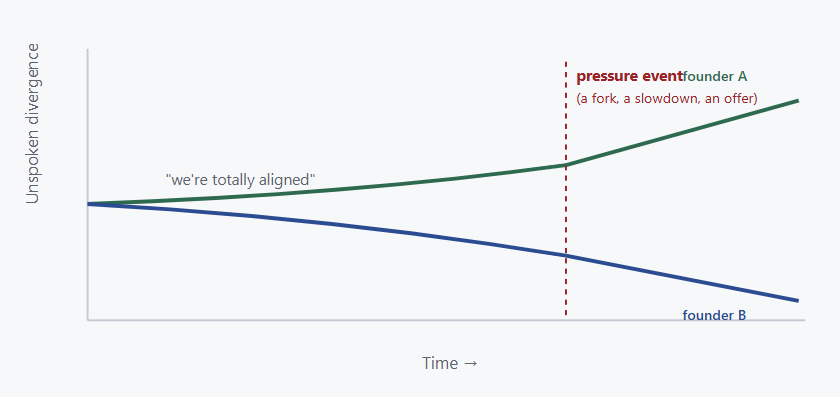
The pattern: assumptions diverge slowly and invisibly while there's nothing to fight about. A pressure event — an acquisition offer, a cash crunch, a strategic fork — turns a hairline gap into a split. The crack was there for months; the event only revealed it.
Where the pressure lands
The fault line cracks along predictable seams. Commitment, when one founder is all-in and the other is hedging and the gap finally shows. Equity, when an early "let's just split it evenly" curdles into resentment as contributions diverge. Roles, when two generalists who did everything together now both think they should run the same function. Decision rights, when a 50/50 split that felt fair produces a deadlock no one can break. And ambition — the quiet killer — when one founder is building a life's work and the other is building toward an exit, and they've never compared the two pictures.
None of these are exotic. Every one is foreseeable. That's what makes the fault line such a tragic way to lose a company: the risk is almost entirely preventable, defused by conversations founders skip because the conversations are uncomfortable and the company isn't on fire yet.
Chemistry is a risk factor, not a safeguard
Here's the counterintuitive part. Founders treat great personal chemistry as protection — we get along so well, we'll figure anything out. It's closer to the opposite. The better the early relationship, the stronger the incentive to avoid the awkward structural conversations, because raising them feels like introducing conflict into something that's working beautifully.
The partnerships most exposed to the fault line are often the warmest ones. Friendship doesn't immunize a company against founder conflict. It just delays the diagnosis until the rupture is personal as well as commercial.
The strongest founder relationships aren't the ones with the least friction early. They're the ones willing to manufacture a little friction on purpose — to have the hard conversation while it's hypothetical, before a real event forces it while everyone's emotional and the cap table is at stake.
Visual 2 — The conversations to have before the pressure
Seam | The question to ask early | The assumption it surfaces |
|---|---|---|
Commitment | What would make either of us walk away? | Whether you're equally all-in |
Equity & vesting | What happens to shares if one of us leaves? | Whether "equal" survives unequal effort |
Roles & decisions | Who has the final call when we disagree? | Whether 50/50 means deadlock |
Ambition & exit | Are we building to keep or building to sell? | Whether you even want the same outcome |
How to use it: these are the founder equivalent of a prenup — best discussed while you still like each other, with vesting schedules and decision rights written down, not left to goodwill.
What this means for founders
Treat the relationship as core infrastructure, not a given. You'd never leave the cap table or the IP assignment to "we'll sort it out later." The alignment between founders deserves the same rigor — explicit roles, real vesting, a named tiebreaker for deadlocks, and a written answer to what happens if someone leaves. Putting it on paper isn't cynicism. It's the version of trust that survives a bad quarter.
Schedule the uncomfortable conversation before you need it. Once a year, deliberately ask each other the questions in that table — not because something's wrong, but specifically because nothing is. Divergence caught early is a conversation. Caught during a crisis, it's a breakup with lawyers attached.
And take a real divergence seriously the first time you see it, instead of papering over it to keep the peace. A gap in ambition or commitment doesn't shrink if you ignore it; it compounds quietly until an event makes it unmissable. The founders who last aren't the ones who never disagree. They're the ones who surfaced the disagreements while they were still cheap to resolve.
A LookatBusiness original. Scenarios are illustrative composites. Co-founder conflict is consistently cited among the leading non-market causes of early-stage company failure.