
Most organizations can't answer a simple question about any important call: who, exactly, gets to make it. That ambiguity is quietly the most expensive thing in the building.
A pricing change had been "decided" four times. The first time, in a leadership offsite. The second, in a follow-up where someone who'd missed the offsite reopened it. The third, after a sales VP escalated to the CEO. The fourth, in a meeting called to finally settle the thing the first three meetings had already settled. Six months had passed. The price was still the old price. And not one person in the building could tell you who actually had the authority to set it.
That's not a failure of intelligence or effort. Everyone in those rooms was sharp and well-intentioned. It's a failure of one specific, invisible thing: nobody knew who got to decide.
Ask the people inside an organization to name the slowest, most frustrating part of their work, and they'll describe symptoms — too many meetings, endless alignment, decisions that won't stay decided. Push past the symptoms and you almost always find the same root cause. The decision rights are fuzzy. It's unclear who decides, who advises, and who's simply along for the ride. And that fuzziness is the most expensive condition in the company, precisely because it never appears on any budget line.
The decision that won't stay decided
The clearest tell is a call that keeps coming back from the dead. A choice gets made in a meeting, and a week later it's open again — because someone who wasn't there objects, or someone who was there but disagreed quietly works to reverse it, or nobody's quite sure it was ever really final.
When decisions don't stick, every important call becomes a standing negotiation. People stop treating "we decided" as binding, because experience taught them it isn't. So they hedge, they relitigate, they wait to see if it holds. The organization develops a kind of decision insomnia — endless half-sleep, never fully resolved, never fully at rest.
It's authority, not alignment
Here's where most leadership teams misdiagnose themselves, and the misdiagnosis is expensive. When decisions keep reopening, the reflexive conclusion is that people aren't aligned — so the fix is more alignment. More all-hands context. More pre-reads. More meetings to get everyone on the same page.
More meetings and more alignment are not the cure for fuzzy decision rights. They're the symptom — the elaborate ritual an organization builds to compensate for never having said who gets to decide. Adding more of them makes the disease worse.
Think about why. When authority is clear, you don't need a room full of people to align — the decider listens to input and decides, and everyone else gets on with it. The endless alignment meeting exists precisely because no one has the authority to end the conversation. So the organization substitutes consensus for authority, which means every dissenter holds a veto, which means nothing closes until everyone is exhausted. Adding meetings to that system doesn't resolve it. It just gives the unassigned authority more rooms to hide in.
Three roles, constantly blurred
Most decisions involve three distinct roles, and the trouble starts when they collapse into one undifferentiated blob.
The decider is the single person who makes the call and owns the outcome. Not a committee — a person. The advisor is someone whose input the decider is obligated to seek and seriously weigh, but who does not get a vote. The informed are people who need to know the outcome so they can act on it, but who have no input into the decision itself.
When these are clear, decisions move. When they blur, everything goes sideways. Advisors think they're deciders and feel betrayed when overruled. The informed think they're advisors and clog the process with input nobody asked for. And the actual decider, sensing the crowd, hesitates to decide at all — because it no longer feels like their call to make.
Visual 1 — Decider, advisor, informed
Role | What they actually do | Common failure when the line blurs |
|---|---|---|
Decider | Makes the final call; owns the result; one person, not a committee | Hesitates to decide because the crowd makes it feel like a group call |
Advisor | Gives input the decider must seek and weigh — but holds no vote | Believes they had a vote; treats being overruled as betrayal |
Informed | Needs the outcome to act; has no input into the decision | Inserts opinions, reopens settled calls, and slows everything down |
How to use it: for any stuck decision, name a single person in each row. If you can't name one decider, that's your problem — not a lack of alignment.
What fuzziness actually costs
The bill comes in three currencies, and none of them shows up where finance is looking.
The first is speed. Every decision that should take a day takes three weeks, because it has to be socialized, re-socialized, and survived. Multiply that across hundreds of decisions and the whole organization moves at a fraction of its real capacity. The second is accountability. When five people sort-of decided, no one decided, and no one owns the outcome — so when it goes wrong, there's no one to learn from and nothing to correct. Diffuse authority produces diffuse responsibility, every time. The third, and most corrosive, is resentment. People who thought they had a say discover they didn't. People who made a call get second-guessed by those who weren't accountable for it. Trust erodes, and the next decision gets even harder.
Visual 2 — With vs. without clear decision rights
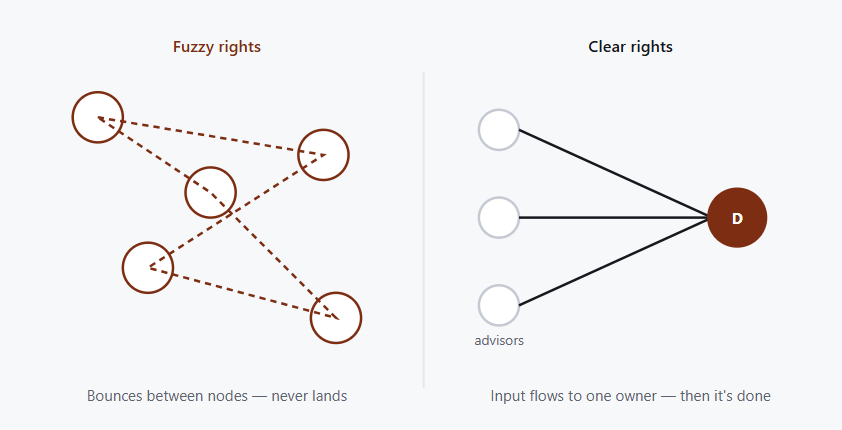
Conceptual model. Same inputs, two systems. On the left, authority is unassigned and the decision ricochets indefinitely. On the right, advisors feed a single decider — the call lands once and stays landed.
Assigning the "D"
The fix is unglamorous and nearly free: for any decision that matters, name one person who decides. Not a committee, not "the leadership team" — a single human with a name. Make it explicit, write it down, and say it out loud in the room: "On this, Maya decides. We'll all give input; she makes the call."
That sentence does an enormous amount of work. It tells the advisors their job is to inform, not to vote. It tells the informed to plan around the outcome, not to relitigate it. And it tells the decider that the call is genuinely theirs — which is the thing that lets them actually make it. Clear decision rights aren't bureaucracy. They're leadership infrastructure, the plumbing that lets an organization move without flooding the basement.
The discipline of not re-opening
Assigning the decider is the easy half. The hard half is the discipline to let decisions stay decided. A decision rule means nothing if any senior person can reopen any call by raising it again loudly enough. Once Maya decides, the leader's job is to defend the decision against relitigation — including from people more senior than Maya — unless genuinely new information appears. Disagree and commit is not a slogan; it's the load-bearing habit that makes decision rights real. Without it, you've just added a name to the chaos.
What this means for leaders
Stop treating slow decisions as an alignment problem. The instinct to add a meeting, a pre-read, or another round of socialization is treating the symptom and feeding the disease. When a decision keeps reopening, the question is never "how do we get more aligned?" It's "who, by name, gets to end this conversation?" — and the fact that you can't answer is the entire issue.
Name a single decider for every call that matters, and say it out loud. The ambiguity costs you speed, accountability, and trust, all invisibly, all the time. A sentence that takes ten seconds — "she decides, we advise" — recovers all three. The discomfort of naming one owner is trivial against the cost of letting five people sort-of own it.
Defend decisions after they're made, especially against the powerful. The decision rule fails the first time a senior voice reopens a settled call and gets away with it, because everyone watching learns that "decided" is negotiable. Protecting a decision you might have made differently is the price of having decision rights at all. The organizations that move fastest aren't the ones with the smartest people in the room. They're the ones where everyone knows who's holding the pen.
A LookatBusiness original.