
Most leadership advice assumes you built your team. Far more often you inherit one — with loyalties, habits, and a history you weren't part of. The first moves you make decide everything.
A newly promoted VP walked into his first staff meeting with a plan. He'd spent his first week reading the org chart, the last two quarters of numbers, and a thick deck his predecessor left behind. By Friday he announced a reorg, killed two projects, and reassigned three people. He thought he was demonstrating decisiveness. What the room saw was a stranger rearranging their lives before he'd learned a single name beyond the title attached to it.
Within a quarter, two of his strongest people had quietly started looking. He never connected the exits to the meeting. He thought he'd shown leadership. He'd shown contempt for everything that existed before him.
Almost all of the leadership canon is written for a situation most leaders rarely face: building a team from scratch, picking each person, setting the culture by hand. Real careers don't work that way. You usually walk into a team that already exists — with its own loyalties, its own grudges, its own way of doing things, and a history you had no part in. Leading a team you inherited is a different problem from building one, and treating it like the same problem is how good leaders quietly fail in their first year.
Inherited is not built
When you build a team, every person chose to follow you, or at least chose to join something you were creating. The authority comes packaged with the relationship. When you inherit a team, none of that is true. These people didn't choose you. Many of them may have wanted your job, or wanted it for a colleague. Their loyalty is to each other and to the way things worked before you arrived — which, from their seat, worked fine.
That means the title gives you formal authority and almost no real authority. You have the right to give instructions. You have not yet earned the right to be followed willingly, which is the only kind that matters when things get hard. The first ninety days are about closing that gap — and the instinct most leaders bring makes it wider.
The two ways it goes wrong
Under the discomfort of inheriting people who didn't pick you, leaders tend to lurch toward one of two failure modes.
The first is the bulldozer. Anxious to assert control, the new leader changes things fast and visibly — new structure, new priorities, new rules — to prove they're in charge. It feels strong. It reads, to the team, as a verdict that everything they built was wrong, delivered by someone who hasn't earned the standing to judge. The capable people, who have options, leave. The ones who stay learn to keep their heads down.
The second is the ghost. Terrified of breaking something or alienating anyone, the new leader changes nothing, defers to the existing power structure, and waits to be accepted. This reads as weakness. The team concludes the new boss is a passenger, the old informal leaders keep running things, and the leader spends a year as a figurehead who never actually took the job.
Visual 1 — The bulldozer, the ghost, and the better path
Dimension | The bulldozer | The ghost | The better path |
|---|---|---|---|
Pace of change | Fast, sweeping, in week one | None; waits to be accepted | Slow to diagnose, then one decisive move |
Signal sent | "Everything you built was wrong" | "I'm a passenger, not the driver" | "I respect what works and will fix what doesn't" |
What breaks | Your best people quit; trust collapses | Real authority never transfers to you | Friction with a few, credibility with the rest |
Who you lose | The capable ones with options | No one yet — and that's the problem | Only those who won't operate either way |
How to use it: both failure modes feel like leadership from the inside — one feels strong, one feels safe. The better path feels uncomfortable, because it asks you to act before you're certain and wait when you'd rather move.
Diagnose before you prescribe
The single most valuable thing you can do in your first month is also the hardest for an ambitious person: withhold judgment long enough to actually understand what you walked into. Most of what looks broken on day one is broken for a reason you can't yet see. The clunky process exists because of a failure three years ago. The two teams that don't talk have a history. The person everyone routes around is the only one who knows how the legacy system works.
So you listen first — not as a courtesy, but as reconnaissance. Talk to every person individually. Ask what's working, what's broken, what they'd fix if they had your job, and what they hope you don't touch. You're not just gathering information. You're learning where the real power sits, which is almost never where the org chart says it does.
Resistance is not the enemy
Here's the turn most new leaders miss, because it's counterintuitive and a little galling. The person who pushes back on you hardest is frequently the one most worth keeping.
The loudest resister usually isn't your problem. They care enough to fight, they know where the bodies are buried, and they're telling you something true about the organization that the agreeable people are too polite to say.
Compliance is cheap and tells you nothing. The person who nods at everything is often the one who's already decided you won't be here long, or who never cared enough to argue. The resister is engaged. They're also, frequently, the institutional memory — the one who can explain why the obvious fix you're about to make has been tried twice and blew up both times.
The skill is distinguishing two things that look identical from the outside: resistance that's protecting turf or comfort, and resistance that's protecting hard-won knowledge you don't yet have. The first you eventually have to move through. The second you should treat as a gift, because it's saving you from an expensive mistake. You can't tell them apart by how loud the person is. You tell them apart by whether the objection survives a genuine "help me understand why."
The credibility you have to earn
You arrive with borrowed authority and have to convert it into the real thing. That conversion happens through small, visible acts of competence and fairness, not through a vision speech. The team is watching how you handle the first hard call, the first conflict, the first time someone tests you. They're asking a simple question: is this person fair, do they understand our work, and will they have our backs?
Notice that none of those questions is about strategy. Strategy earns you nothing in month one because the team has no reason yet to believe you'll execute it. Trust comes first; the mandate to change things comes after — and only after.
Visual 2 — The first 90 days as an arc
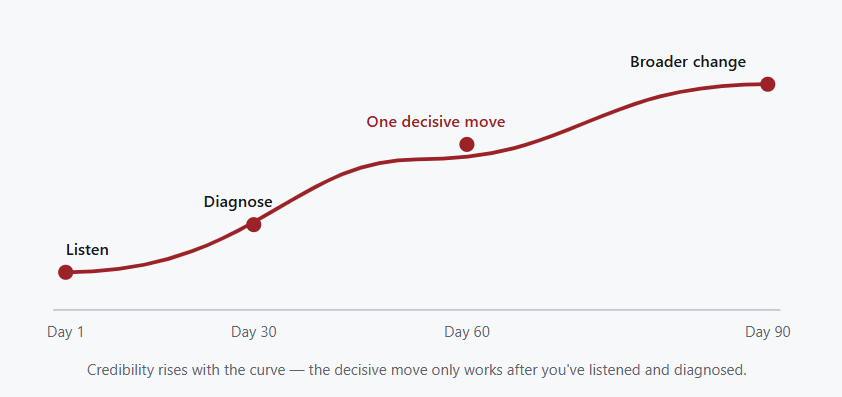
Illustrative. The arc deliberately front-loads restraint. The single decisive act around day 60 isn't a sweeping reorg — it's one clear decision that signals your values. Broad change comes last, once you've earned the standing to make it.
The one early act that signals values
Restraint is not the same as paralysis. Somewhere in the first sixty days, you should make one clear, decisive call — not the biggest one available, but the most revealing. Protect someone who was being treated unfairly. Kill a vanity project everyone privately knew was waste. Back a person who took a smart risk and got punished for it under the old regime. The content matters less than what it broadcasts: this is what I stand for, and here's proof it's not just talk.
That single act does more to convert borrowed authority into earned authority than a quarter of careful listening. The listening gives you the right to act; the act tells them who you are.
What this means for leaders
Treat inheriting a team as its own discipline, not a lesser version of building one. The playbook for assembling a team you chose actively misleads you when the team chose nothing. You have formal authority and no real authority on day one, and the entire job of the first quarter is converting one into the other without breaking what already works.
Read your resisters before you reroute around them. The person fighting you hardest is carrying either a turf problem or institutional knowledge you desperately need, and the two look identical from across the table. Run every serious objection through a genuine "help me understand why" before you decide which one you're looking at. You'll keep people you'd otherwise have lost.
Move slowly on judgment and decisively on values. Diagnose longer than feels comfortable, then make one early call that shows the team what you'll protect and what you won't tolerate. The leaders who lose inherited teams almost always got the sequence backward — they prescribed before they understood, and changed everything before they'd earned the right to change anything.
A LookatBusiness original. Scenarios are composites drawn from common leadership transitions, not specific individuals or companies.