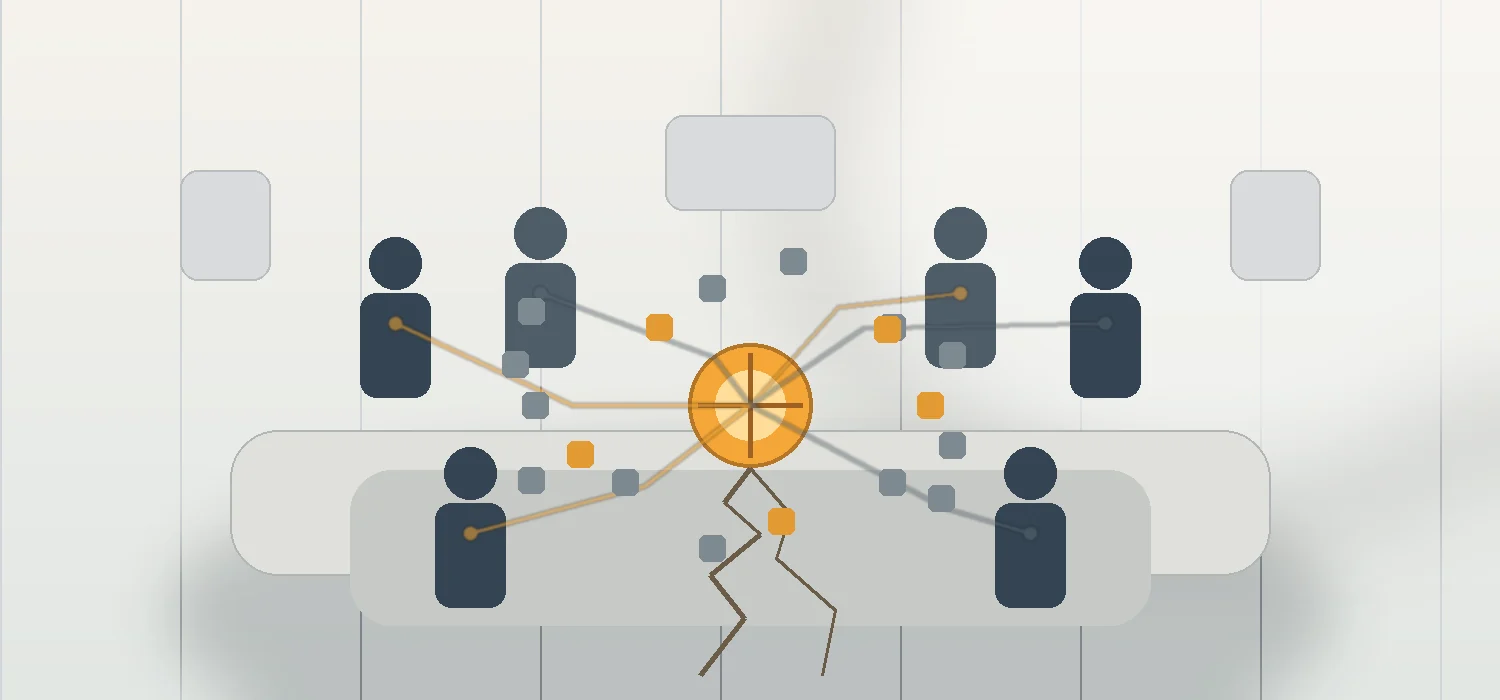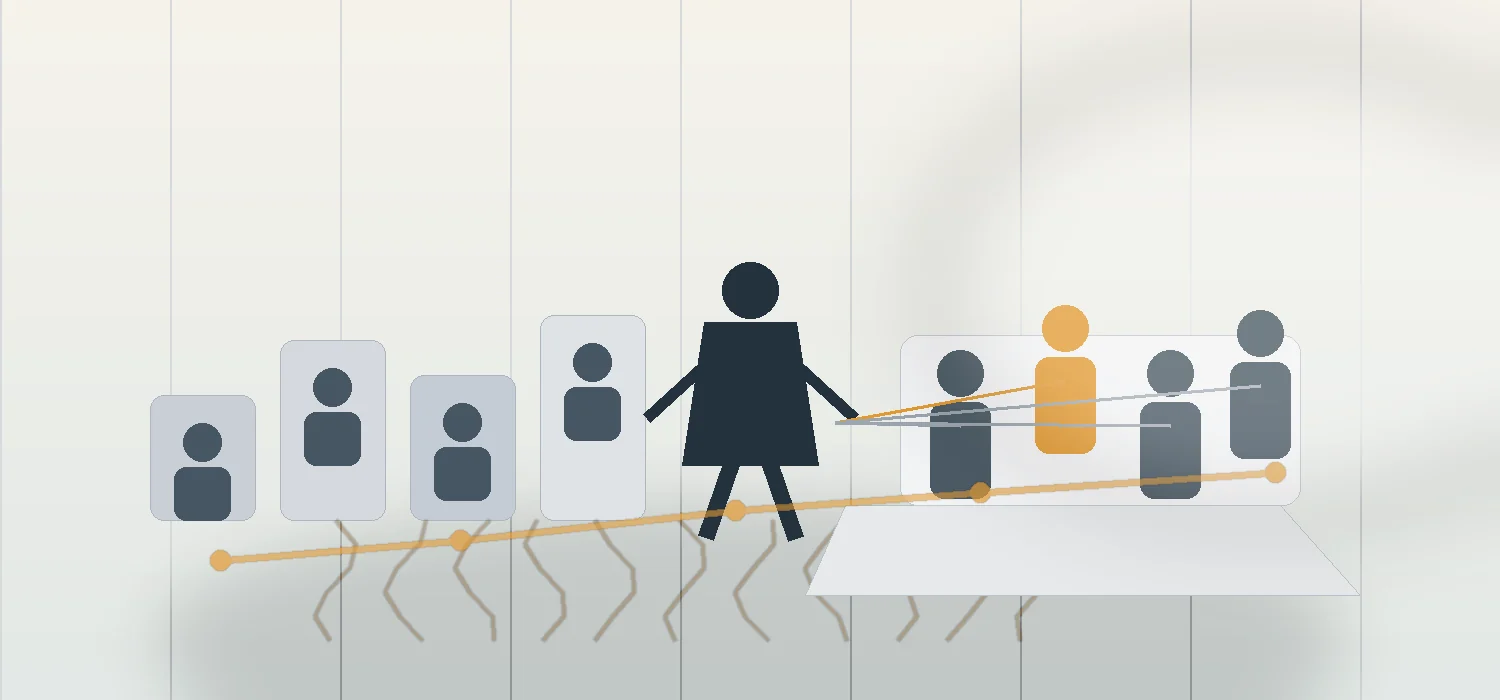

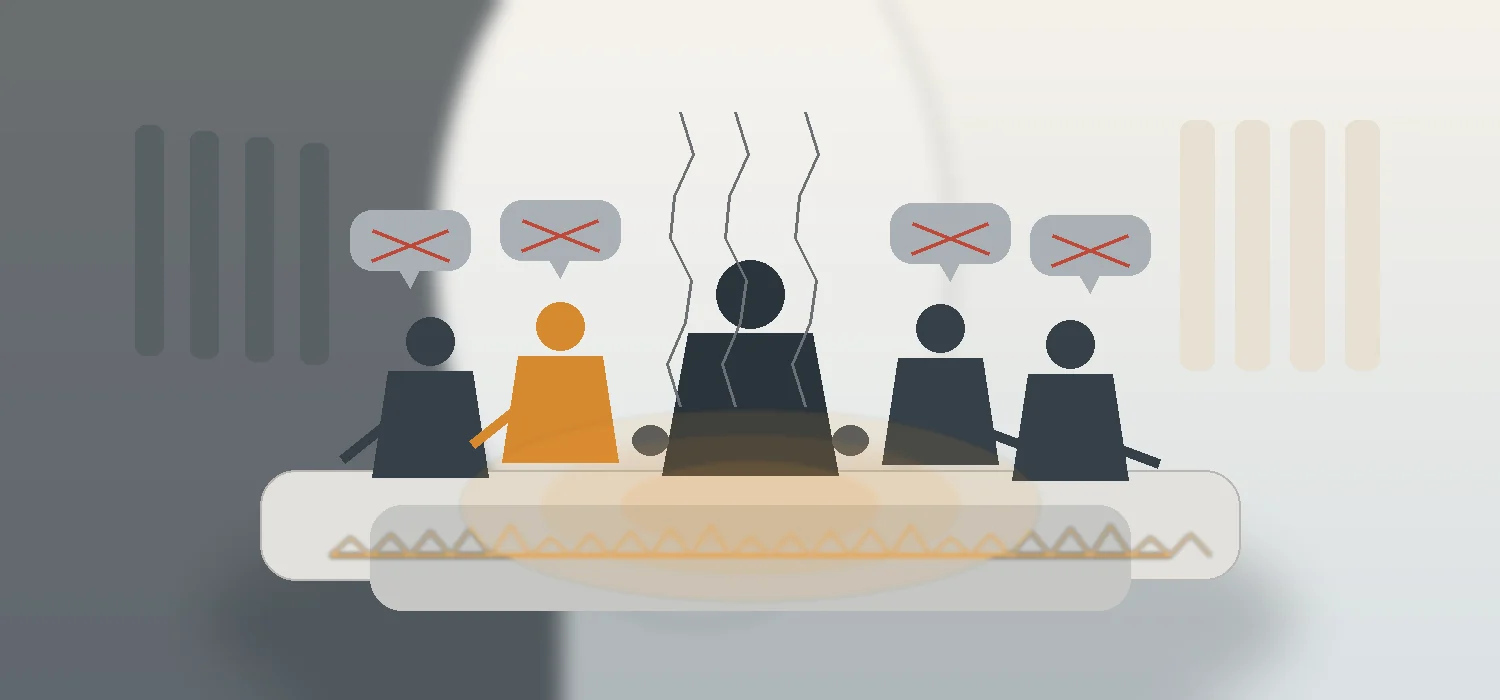
The higher you rise, the more filtered your information gets — until you're making decisions on a sanitized version of reality and don't know it.
A division head once described the moment she realized something was wrong. A product launch was sliding — badly — and she heard about it nine days before the deadline, in a meeting where four people clearly already knew. None of them had been hiding. They'd each assumed someone else would raise it, and each had privately decided it wasn't their problem to surface to her. By the time it reached her desk, the window to fix it cheaply had closed.
She didn't have a courage problem on her team. She had a candor problem, and she had built it herself.
This is the quiet trap of senior leadership. The further up you go, the better the news gets — not because reality improved, but because the people around you got more careful about what they let through. You end up running the company on a flattering, lightly delayed version of the truth. And the most dangerous part is that it feels fine. The reports are clean. The meetings are calm. Nobody is yelling. That calm is often the symptom.
Your reality arrives pre-filtered
Information doesn't travel up an organization in its raw form. It passes through people, and people edit. A frontline observation that starts as "this is broken and customers are leaving" becomes, three layers up, "we're seeing some headwinds we're actively managing." Nobody lied. Each person rounded toward safety, and the rounding compounds.
By the time the signal reaches you, it has been smoothed at every relay. The sharp edges — the ones that would actually prompt a decision — get sanded off, because sharp edges are what get the messenger noticed, and being noticed is risk. You receive the average of everyone's caution.
Visual 1 — The information filter
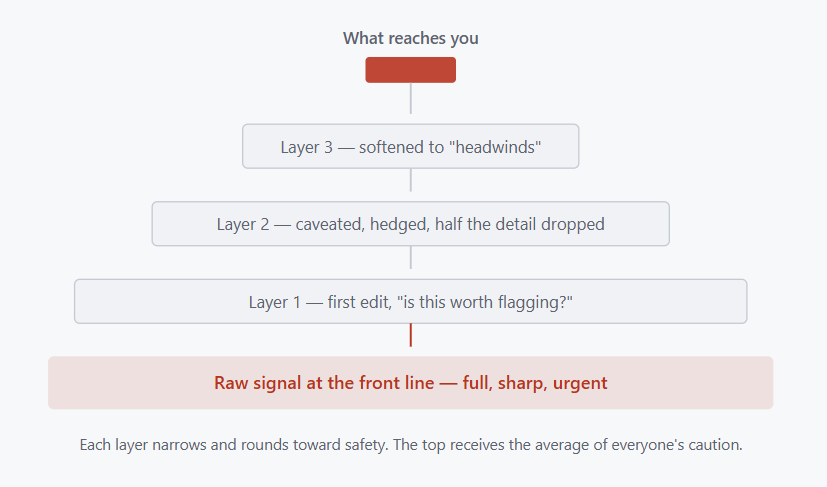
Conceptual model. The truth is widest and sharpest where the work happens. By the time it reaches the executive it has been narrowed at every relay — not by conspiracy, but by ordinary self-protection compounding layer over layer.
Withholding is the rational move
It's tempting to read silence as weakness — a team that won't speak up, that lacks backbone. That framing flatters the leader and explains nothing. The people staying quiet are usually behaving sensibly given the incentives you've set.
Think about what a person actually weighs before delivering bad news to power. The upside of speaking is abstract and deferred: maybe the org benefits eventually, maybe nobody remembers who said it. The downside is concrete and immediate: the boss looks irritated, the meeting runs long, the messenger becomes associated with the problem. When a competent person runs that math and stays quiet, that's not cowardice. That's a correct read of how candor has been priced in your shop.
The same logic governs disagreement. Softening your dissent so it lands gently costs you nothing and keeps you safe. Stating it plainly might be remembered the next time a promotion is decided. So smart people learn to wrap their real view in enough cushioning that it can't quite be heard — and the leader hears agreement.
The tells
Candor collapse is hard to see precisely because it presents as harmony. The warning signs read like good news if you're not looking for them.
Watch for the meeting where everyone agrees too quickly. Genuine alignment is rare; instant alignment usually means people decided in advance that disagreeing wasn't worth it. Watch for surprises that arrive late — problems that were obviously brewing for weeks but reached you only when they could no longer be contained. And watch for the silence that follows you asking "any concerns?" If a real question reliably produces no real answers, the answer is the silence.
What actually kills it
Three behaviors do most of the damage, and leaders rarely notice themselves doing them. Punishing the bearer of bad news — even subtly, with a sigh or a sharper tone — teaches everyone watching that bad news has a cost. Deciding before you've finished hearing, so the input was theater. And letting rank fill the room, where you state your view first and then ask what people think, which is functionally asking them to ratify you.
But here is the part most leaders get wrong about their own situation. The problem is almost never that your team won't speak up. It's what you do in the three seconds after someone does.
Candor doesn't die in the silence. It dies in the three seconds after someone tells you something you didn't want to hear — and your face, your tone, or your first sentence tells the whole room what speaking up will cost.
Those three seconds are the entire system. A person takes a risk and offers you an uncomfortable truth. What you do next is observed not just by them but by everyone in the room, and it sets the price for the next hundred truths. Lean in and get curious, and you've made candor cheaper. React with even a flicker of defensiveness, and you've quietly taught a dozen people to route around you next time. You will not remember the moment. They will.
Visual 2 — What you did vs. what the team learned
What you did in the moment | What the team quietly learned |
|---|---|
Interrupted a half-formed idea to argue it down | Don't bring anything here until it's bulletproof — so we'll bring less, later |
Visibly tensed when handed bad news | Bad news has a cost; delay it until it's undeniable or hide it entirely |
Stated your own view before asking for theirs | The meeting is a ratification, not a discussion; agree and move on |
Asked "any concerns?" then checked your phone | The question is a formality; real concerns aren't actually wanted |
Praised the person who flagged a real risk | Surfacing problems early is safe here; it's worth the awkwardness |
How to read it: the right column is your information system, and you wrote it through accumulated micro-reactions. The last row is the only one that buys you candor — and it's the one that feels least urgent in the moment.
Rebuilding the signal
The repair is slower than the damage and far less satisfying. You can't announce an open-door policy and expect the filtering to stop; people believe what you do under pressure, not what you say in a town hall. Trust is rebuilt one reaction at a time, by being demonstrably safe to tell exactly when it would be easiest to punish.
The most useful habit is to reward the act of surfacing separately from the content. When someone brings you a genuine problem, your first response should make the bringing feel worthwhile, regardless of how much the news stings. Thank them visibly. Ask one real question. Resist the urge to solve, blame, or defend in the same breath. Over time, those reactions reprice candor — and the signal starts arriving sharp again.
What this means for leaders
Assume your picture is flattering and lagging, and discount accordingly. The calm dashboard is not evidence that things are calm; it may be evidence that the people who'd tell you otherwise have learned not to. Build a habit of going one or two levels below your direct reports for unedited signal, not to undercut anyone but to see what got rounded off on the way up.
Treat your own reaction as the variable you control. You cannot mandate courage, but you set its price every time someone takes a risk in front of you. The three seconds after a hard truth are leadership infrastructure. Spend them on curiosity, and you lower the cost of the next hundred truths.
Count the bad news, not the good. A healthy team brings you problems early, while they're still cheap to fix. If the flow of uncomfortable information has gone quiet, that's not peace — it's the filter doing its work. The question worth sitting with is uncomfortable: when did someone last tell you something you genuinely didn't want to hear, and what did your face do when they did?
A LookatBusiness original.