

Someone on your team is exceptional at the actual work. They close the most, ship the cleanest code, run the tightest projects. So when a management seat opens, the decision feels like it makes itself. You promote them. Everyone nods. It reads as meritocracy working exactly as designed.
It's often a mistake — and a peculiarly expensive one, because it fails in two directions at once. You take your best individual producer out of the role they're great at, and you drop them into a role that requires a different skill set they may not have. I call this the Competence Inversion: in a single decision, you lose your strongest doer and acquire a weak manager, and you congratulate yourself for it.
The double cost nobody counts
A normal bad hire costs you one thing: an underperformer in a seat. The default promotion costs you two, and they compound.
The first cost is the output you just removed. Your top performer was producing at the very top of the team; now they're producing slides and one-on-ones instead. The second cost is the team that now reports to someone who has never managed and was promoted for skills that have little to do with managing. A great engineer who micromanages, a star seller who can't coach, a brilliant analyst who avoids hard conversations — each can quietly degrade the output of five other people. The math is brutal: you subtracted your best unit of work and added a drag across a whole team, and the org chart calls it a promotion.
Visual 1 — One decision, two losses
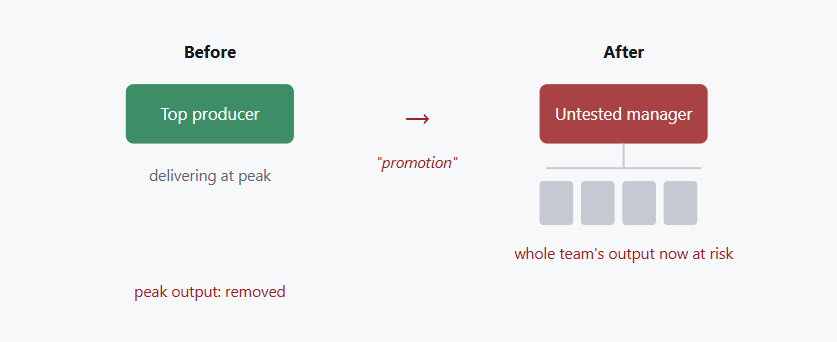
The inversion: the same decision subtracts your best individual output and introduces management risk across a team. Most promotion reviews count neither cost — they count only that a strong performer was "rewarded."
Why we keep doing it anyway
If the failure is this predictable, why is it the default everywhere? Because the alternative feels like a punishment.
In most companies, management is the only path to more money, more status, and more recognition. So "we'd like you to keep doing the thing you're brilliant at" lands as "we're capping you." Telling your best person they're staying put sounds like withholding a reward, even when it's the right call for them and the company. Add the optics — passing over your top performer looks like you don't value excellence — and the incentives all point one way: promote, applaud, move on. The structural problem is that we've fused two unrelated things, reward and management, into a single lever. Pull it for one and you get the other whether you want it or not.
The skills don't just differ. Some of them invert.
The comforting assumption is that a great doer will "grow into" management. Sometimes they do. But the trap is that the two roles don't just require different skills — for some traits, the very thing that made someone a great individual contributor actively works against them as a manager.
The star is often great precisely because they do it themselves, fast, to their own high standard. As a manager, that instinct becomes the inability to delegate, the urge to take the keyboard, the impatience with people slower than them. The perfectionism that made their work excellent makes them a bottleneck and a morale problem. You didn't promote someone with a skill gap you can train away. You promoted someone whose strengths point the wrong direction in the new role.
Visual 2 — What transfers, what doesn't, what backfires
Made them a great individual contributor | As a manager, it becomes… |
|---|---|
Does it themselves, fast, to a high bar | Can't delegate; takes the work back |
Perfectionism and personal standards | Bottleneck; nothing's ever good enough |
Heads-down focus on their own output | Neglects the slow, ambiguous people work |
Wins by being the smartest in the room | Competes with their own team instead of growing it |
The point: these aren't gaps to coach — they're strengths pointed the wrong way. Promotion assumes the traits transfer. For the best individual performers, several of them invert.
The fix isn't "never promote your best people"
Here's the part that matters, because the easy misread of all this is "stop promoting top performers." That's wrong too. Some of your best doers will be excellent leaders, and holding them back is its own expensive mistake.
The error was never promoting the wrong people. It's that we made management the only way to reward the right ones — so the decision got made for the wrong reasons, by default, instead of on the merits.
The fix is to decouple the two. Build a real path where a top individual contributor can earn more money, more status, and more influence without ever managing a person — and make it genuinely equal, not a consolation track everyone can see is second-class. Then promote into management only the people who actually want to lead and show the signs of being able to, regardless of whether they were the highest producer. Sometimes that's your star. Often it's the quietly effective person who already makes everyone around them better and was never the top of the leaderboard.
What this means for leaders
Separate the reward decision from the management decision — structurally, not in spirit. As long as the only way up runs through managing people, you'll keep converting great producers into mediocre managers and calling it merit. The dual-track ladder isn't an HR nicety; it's the thing that stops the inversion at the source.
Promote for evidence of the new job, not excellence at the old one. The question is never "are they the best performer?" It's "have they shown they can make other people better, have hard conversations, and let go of doing it themselves?" Those signals are usually visible before the title, if you look for them instead of looking at the leaderboard.
And make staying a doer an honorable, well-paid choice. The most valuable thing you can do for some of your best people — and for the team that would have reported to them — is to tell them, sincerely and with a raise attached, that you want them to keep being the best in the building at the thing they're the best at. That's not a failure to develop them. It's refusing to break two things to satisfy a convention.
A LookatBusiness original. The pattern echoes the long-observed "Peter Principle," reframed as a decision leaders make rather than an inevitability.