


"First-mover advantage" is one of the most quoted ideas in business and one of the least examined. The pioneer often clears the path and the follower takes the market.
Think of the products you actually use every day. How many were made by whoever got there first? The search engine, the smartphone, the social network, the streaming service you pay for — in most of those categories, the company you rely on was not the pioneer. It was the one that watched the pioneer, learned what didn't work, and showed up second with a better answer.
And yet "first-mover advantage" remains gospel. It gets cited in pitch decks as if being early were itself a strategy, a reason to rush, a justification for burning capital to plant a flag before anyone else. The phrase has the comforting ring of a law of physics. It isn't one.
Being first is real and valuable in a narrow set of conditions. In most others it's a liability — an expensive way to do a competitor's market research for them, at your own cost, in public.
What the pioneer is actually buying
The first mover doesn't just enter a market. They pay to create one, and the bills are larger than the legend admits.
They pay to educate the market. When a category is new, customers don't know they want it; the pioneer spends years and fortunes teaching them. By the time the buyer is convinced, that education is a public good — and the follower walks into a room full of customers who already understand the pitch, having paid nothing to inform them.
They pay for false starts. The first version of anything is built on guesses about what customers want, and many of those guesses are wrong. The pioneer eats the cost of every dead end, every feature nobody used, every assumption the market quietly rejected. The follower reads the results like an answer key.
And they pay the immature-technology tax. Whatever the pioneer builds with is the worst version of the underlying technology it will ever be — the most expensive, the least capable. The follower, arriving eighteen months later, builds the same thing cheaper and better on infrastructure the pioneer helped pay to mature.
Visual 1 — Which game are you in?
Condition | When first genuinely wins | When second wins |
|---|---|---|
Network effects | Early lead snowballs; users attract users | Product is used alone; no compounding from scale |
Switching costs | Customers lock in deep and rarely leave | Switching is cheap; buyers shop freely |
Scarce supply | You grab the limited shelf, spectrum, or sites | Supply is abundant; nothing to corner |
Market maturity | Customers already know they want the category | Buyers need years of education first |
Technology curve | Tech is stable; little advantage in waiting | Tech is improving fast; waiting buys better tools |
How to use it: count your rows. If most of your situation sits in the right-hand column, "move fast to be first" is the wrong instinct. The honest answer for most categories is: second.
When first genuinely wins
The advantage is real when being early triggers something that compounds and locks. Network effects are the clearest case: if every user makes the product more valuable to the next, an early lead can become unassailable before a follower gets traction. Switching costs work similarly — get customers deeply embedded, with their data and workflows entangled in your product, and a late rival has to be not just better but better by enough to justify the pain of leaving. And scarce supply rewards speed in the literal sense: the limited shelf space, the radio spectrum, the prime physical locations go to whoever claims them, and there's no second copy to claim.
These conditions are real. They're also rarer than the people quoting "first-mover advantage" assume. Most markets have weak network effects, low switching costs, and abundant supply — which is to say, most markets are exactly the kind where being first is a cost, not a moat.
The follower's free lunch
The fast-follower runs a structurally better business, and the reason is simple: they get to learn from the pioneer's experiments without paying for them. Every mistake the first mover makes is data the second mover gets for nothing. Every customer objection the pioneer surfaces is a problem the follower can solve on day one. Every market the pioneer proves exists is a market the follower enters with the risk already retired.
Visual 2 — Two paths to the same market
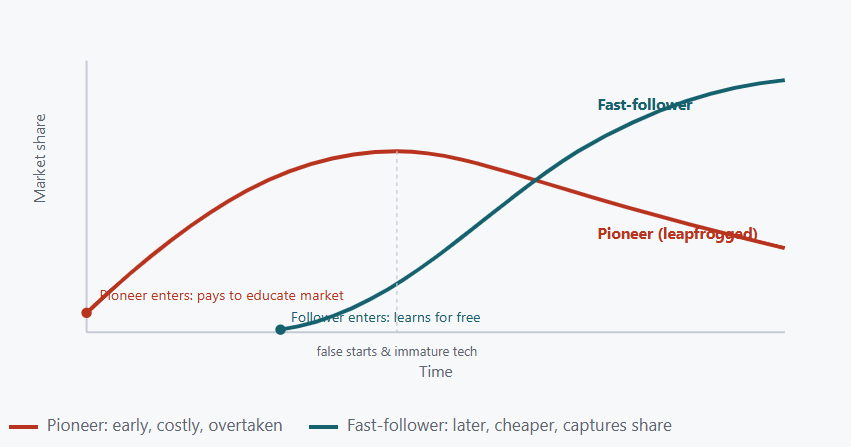
Conceptual model. The pioneer spends to open the category and peaks first. The follower enters once the market is proven, builds on cheaper tech, and climbs past — using the pioneer's mistakes as a map.
This isn't a guaranteed outcome; a lazy follower loses to a great pioneer every time. But the follower starts with a structural cost advantage that compounds in their favor if they have the discipline to use it. The pioneer's hardest, most expensive work — proving the market exists and is worth serving — is already done, and done for free.
The contrarian turn
So here is the part the pitch decks get backwards. The durable advantage was never being earliest. It was being the best learner.
Being first is frequently the most expensive way to lose. The company that wins isn't the one that moved soonest — it's the one that turned someone else's experiment into its own head start.
This reframes the whole question. "How do we get there first?" is usually the wrong thing to optimize. The better question is "How do we learn fastest from whoever does?" Speed of learning beats speed of arrival in every market that lacks the lock-in conditions — and most markets do. The pioneer's flag-planting looks like leadership right up until the follower walks past it with a better product and a lower cost base.
What this means for leaders
Diagnose the game before you pick the speed. Run your category through the conditions: network effects, switching costs, scarce supply. If they're strong, racing to be first can be worth almost any cost. If they're weak — and they usually are — being first is a tax you're volunteering to pay. Most leaders never run this check; they just assume earlier is better and rush into the expensive column.
If you're going to be second, design for it on purpose. A fast-follower strategy isn't passivity; it's an active discipline. Build the machinery to watch pioneers closely, read their public mistakes, and move decisively once the market is proven. Being a deliberate fast second is a strategy. Drifting in late by accident is not.
And stop paying a premium for a bragging right. "We were first" is a line for the press release, not the P&L. The market doesn't award the prize for arriving earliest. It awards it for being the best answer when the customer is finally ready to buy — and that customer rarely remembers, or cares, who showed up first.
The pioneers clear the trail and take the arrows. Sometimes that's the right role to play. More often, the smart money lets someone else find the path, then walks it faster.
A LookatBusiness original.