


A plan assumes you know what will happen. A strategy is a wager on a view of the future that might be wrong — and treating it like a plan is why so many die quietly on a shelf.
The strategy offsite ends the way they always do. Forty slides, a three-year arc, a tidy set of pillars with verbs in front of them. Everyone nods. The deck goes into a shared drive. And then, for the next eleven months, almost nobody looks at it — not because they're lazy, but because there's nothing in it that tells them when it's wrong.
That's the quiet death of most corporate strategy. Not a dramatic failure. A slow irrelevance, because the document was built to be admired, not tested.
The root cause is a category error. We dress strategy up as a plan — a confident statement of what we will do and when — when it is actually a bet: a wager on a particular view of how the future breaks. A plan implies you know what's going to happen. A strategy concedes that you don't, and commits anyway. The two are not the same kind of object, and treating one like the other breaks it.
Why plans resist the one thing that matters
A plan, by its nature, resists updating. It was approved. People are accountable to it. Changing it looks like having been wrong, and organizations are exquisitely engineered to avoid looking wrong. So the plan calcifies. Evidence arrives that the world isn't behaving as assumed, and instead of revising, the team explains the evidence away — sunk cost dressed as conviction.
There's an identity problem too. After enough internal repetition, the plan stops being a hypothesis and becomes who we are. "We're the company that's going upmarket." Now abandoning the move isn't a course correction, it's an existential threat. The plan has fused with the org's self-image, and you can't run an experiment on your own identity.
A bet has none of this baggage, because a bet expects to be resolved. You place it knowing it might not pay. You attach conditions under which you'll walk away. Nobody is humiliated when a bet doesn't hit; they're humiliated when they refused to fold a losing one. That single shift — from a thing you defend to a thing you settle — changes everything downstream.
Visual 1 — Two mindsets
Dimension | Plan mindset | Bet mindset |
|---|---|---|
Assumptions | Buried in the logic, rarely named | Stated explicitly, listed as load-bearing |
Success metric | "Did we execute the steps?" | "Did the underlying view turn out true?" |
When you change | When it becomes impossible to deny | When pre-set evidence trips a line |
Failure response | Explain it away, protect the slide | Resolve the bet, redeploy the capital |
Emotional cost of stopping | High — feels like being wrong | Low — folding is part of the game |
What it shows: the same strategy, held two ways. The plan mindset optimizes for looking right; the bet mindset optimizes for getting the answer. Only one of them can update before it's too late.
Name the load-bearing assumptions
Every strategy rests on a small number of beliefs that, if wrong, bring the whole thing down. The discipline is to write them out, in plain language, before you commit. "This works only if mid-market buyers will pay a premium for integration." "This works only if regulation stays where it is." "This works only if we can hire fifty engineers in this market at this comp."
Most decks never do this, and the omission is not accidental. Naming the assumptions makes the bet falsifiable, and a falsifiable strategy can fail in public. A vague one can't, which is exactly why vague ones are so popular. But an assumption you won't write down is one you can't monitor, and one you can't monitor will surprise you at the worst possible time.
Set the kill line and the scale line first
Here's the move that turns a bet into a usable instrument: decide, in advance, what evidence would make you stop, and what evidence would make you double down. Not after the data arrives — before, while you're still honest, before the sunk cost and the identity have a say.
A kill line is a specific, pre-committed condition: "If we haven't hit X by Q3, we wind this down." A scale line is its twin: "If we clear Y, we move the budget here from everything else." Written ahead of time, these protect you from your own future rationalizations. Written nowhere, you'll find — every time — that the data is "still inconclusive" and the project staggers on for another two quarters, consuming the resources a sharper bet deserved.
Visual 2 — The strategy bet card
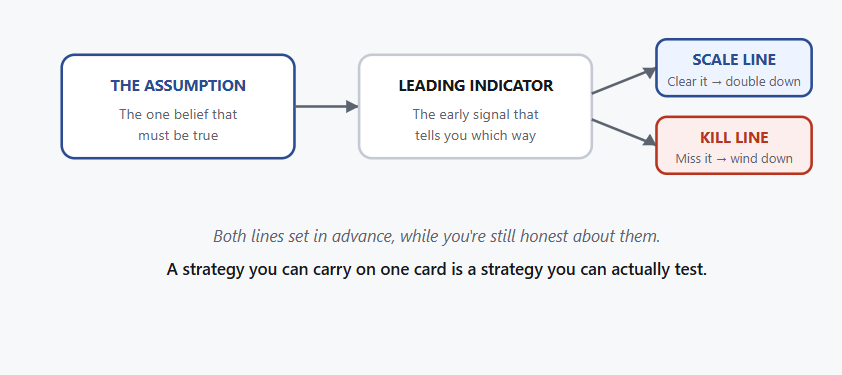
Illustrative. One bet, one card: the belief, the signal that resolves it, and the two lines you committed to before the evidence arrived. Most strategies can't fit on this card because they were never specific enough to.
The contrarian standard
This leads to a test that most leaders flinch at. A good strategy must be specific enough to be wrong.
If no piece of evidence could ever prove your strategy mistaken, you don't have a strategy. You have a vision statement that survives because it can't be falsified.
"We will be the trusted leader in customer-centric solutions" cannot fail, because it predicts nothing. There is no quarter in which reality contradicts it, no number that disproves it, no fact that would force a change. That immunity feels like strength. It's the opposite. A claim that can't be wrong can't be right either; it's just noise that polls well internally.
The strategies worth having are the ones that stick their neck out. "Buyers will consolidate onto a single platform within two years, and we'll be it." That can be checked. It can be wrong by a specific date for a specific reason. And because it can be wrong, it can teach you something — which is the only thing a strategy is actually for.
Changing your mind without thrashing
The obvious objection: doesn't this just license endless flip-flopping? It's the reverse. Pre-set criteria are what separate updating on evidence from updating on whim. The rigid company never changes until it's forced; the chaotic one changes every time a competitor sneezes. Both are failures of the same missing discipline.
A bet with named assumptions and pre-committed lines gives you a third path. You change when the evidence you said would matter actually shows up — and not before. The criteria are the guardrail against both diseases: they stop you defending a corpse, and they stop you abandoning a bet that's merely young. Conviction and adaptability stop being opposites and start being the same habit.
What this means for leaders
Audit your strategy for falsifiability. Read your current strategy and ask: what would have to happen for us to admit this was wrong? If you can't name it in a sentence, you're holding a vision, not a wager. Sharpen it until it can fail.
Make every major bet wear its lines in public. For each big commitment, write the load-bearing assumption, the leading indicator, and the kill and scale lines — before the money moves. The act of writing them is where most of the strategic thinking actually happens. Everything before that was just ambition.
Reward folding, not just winning. The team that kills a losing bet on schedule did something harder and more valuable than the team that rode a good one. If your culture only celebrates the bets that hit, you're training people to defend the ones that don't — and the shelf fills up with strategies nobody will admit are already dead.
The future doesn't care how confident your deck was. It only resolves your bets, one by one, on its own timeline. The question is whether you built a strategy that can hear the answer — or one designed never to have to.
A LookatBusiness original.