

The most expensive decisions in your company are the ones nobody is making. Here's how to read the ledger.
Every leadership team has a decision it has been not-making for months.
The underperforming executive everyone has quietly stopped relying on. The product line that hasn't earned its shelf space in two years. The market you keep "monitoring." The reorg that gets raised in every offsite and survives every one of them. These calls don't sit in a queue waiting their turn. They sit on a balance sheet you can't see, accruing interest in a currency you don't track until the bill arrives all at once.
I call this Decision Debt. It is the gap between the decisions a business needs to make and the ones its leaders are willing to make, and it behaves exactly like financial debt: cheap to take on, easy to ignore, and brutal when it compounds.
The dangerous part isn't that leaders make bad calls. Bad calls at least generate feedback. Decision Debt is built from the calls that never get made at all — the ones that look, from the inside, like prudence.
Why this is a 2026 problem, not a timeless one
There has never been a better year to avoid a decision and call it strategy.
US CEOs now name uncertainty as their single biggest threat for the year — 43% rank it at the top, well above the 29% of their global peers. Forward-looking sentiment has turned negative for the first time in five quarters. Policy uncertainty, by some measures, sits higher than it did during the financial crisis or the pandemic. Nearly half of CEOs say tariff volatility alone has stalled their investment decisions.
Read that environment one way and it counsels patience. Read it the way most organizations actually behave and it counsels paralysis dressed as patience. When the macro picture is genuinely murky, "let's wait for more clarity" stops being a judgment and becomes a reflex — and a socially rewarded one. Nobody gets fired for waiting in a fog.
The tell is in how leaders spend their hours. CEOs now report devoting 47% of their time to issues with a horizon under twelve months and just 16% to anything beyond five years. That is not a calendar problem. It is a portfolio of hard, long-range calls being refinanced, month after month, into short-term busywork. The debt doesn't disappear. It just moves off the agenda and onto the books.
The three forms the debt takes
Decision Debt isn't one thing. It shows up in three forms, and they hide in different places.
Deferred debt is the honest kind. You know the decision needs making, you've named it, and you've chosen "not yet." A pricing change, a market exit, a leadership change. The intent to decide exists; the willingness doesn't. This is the debt most leaders will admit to.
Defaulted debt is more dangerous because no one experiences it as a decision at all. By declining to choose, you've let circumstance choose for you. The talented engineer you didn't promote takes the recruiter's call. The budget you didn't reallocate gets spent the way it was last year. Inaction is not neutral. It is a vote for the status quo, cast silently, and it counts.
Disguised debt is the most expensive of the three, because it wears the costume of progress. This is the decision sent back for "more analysis," the question routed to a working group, the call that becomes a Q3 deliverable about whether to make the call. Motion gets mistaken for momentum. The organization feels busy. The decision is exactly where it was, now with a deck attached.
Visual 1 — The three forms of Decision Debt
Deferred
Named, understood, and consciously put off. "Not yet."
e.g. A pricing change everyone agrees on but no one schedules.
Interest accruedOption decay — alternatives quietly expire
Defaulted
Never felt like a decision; inaction chose for you.
e.g. The engineer you didn't promote takes the recruiter's call.
Interest accruedTalent & competitor drift toward the status quo
Disguised
Re-routed for "more analysis." Motion mistaken for momentum.
e.g. A call becomes a working group about whether to make the call.
Interest accruedAnalysis cost plus the delay it conceals
What it shows: a shared vocabulary for spotting which debt you're carrying. The point: disguised debt is the only one that feels like work — which is exactly why it goes unpaid the longest.
What the interest is actually charging you
Financial debt charges interest in money. Decision Debt charges in four currencies, and they compound against each other.
The first is optionality. Most hard calls get cheaper to make early and more expensive later, because the alternatives quietly expire. The executive change you make in Q1 is a managed transition; the same change in Q4, after a key client has noticed, is damage control. Waiting rarely buys you better options. More often it spends the ones you had.
The second is momentum. Organizations take their cues from what leadership is visibly willing to resolve. A team that watches an obvious call go unmade for two quarters learns the real lesson: hard things don't get decided here. That lesson is portable. It shows up later as the strong performer who stops raising issues because raising them changes nothing.
The third is credibility, and it's the one leaders underestimate most. Every named-but-unmade decision is a small public IOU. People can see the gap between what the leadership team says matters and what it's actually prepared to act on. Carry too many of those IOUs and you don't just lose a decision — you lose the benefit of the doubt on the next one.
The fourth is information decay, which is the cruel twist. The whole premise of waiting is that you're buying better information. But most decisions don't get clearer with time; they get noisier. By the time the "clarity" arrives, the situation has moved, and you're now making a stale decision with a confident face.
Visual 2 — The cost-of-deciding curve
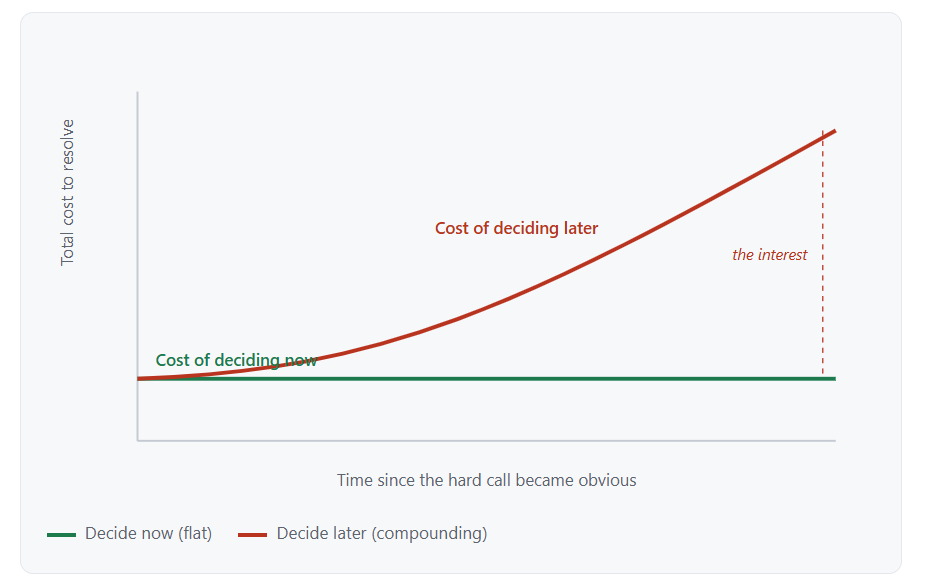
Conceptual model, not measured data. The gap between the two lines is the interest on the debt — and it widens fastest at the exact point where waiting feels safest.
The part most frameworks get wrong
Here's where I'll break from the usual advice, which is some version of "great leaders decide fast." That's lazy. Speed is not the virtue, and treating it as one produces a different failure mode — the leader who confuses decisiveness with twitchiness and rips up strategy every quarter.
Some deferral is genuinely the right call. The honest question is never "fast or slow." It's "am I waiting because new information is actually arriving, or because deciding is uncomfortable?"
Legitimate deferral has a trigger and a deadline. Decision Debt has a vibe — "let's keep an eye on it" — and an open end. The first is a position. The second is avoidance with a calendar invite.
Those two look identical from the outside and feel completely different from the inside, if you're honest with yourself. The good news is that the difference is testable.
Visual 3 — Legitimate deferral vs. Decision Debt
The test | Legitimate deferral | Decision Debt |
|---|---|---|
Is there a specific trigger to decide? | Yes — named and concrete | No — "we'll see" |
Is there a hard deadline to revisit? | Yes — on the calendar | No — open-ended |
Is new information genuinely arriving? | Yes — and you know when | No — just more discussion |
Would more time change the answer? | Plausibly | Unlikely |
Can you name what you're waiting for? | In one sentence | Only in vibes |
A usable self-diagnostic. Most "strategic patience" fails three or more of these rows — which is the tell that it's debt, not judgment.
Reading your own ledger
You can audit this in an afternoon, and most leadership teams have never tried.
Write down every decision your team has discussed more than twice without resolving. For each one, force three answers. What is it specifically waiting on — and is that thing actually coming? What has it already cost in the four currencies since it landed on the table? And what does inaction silently choose, if you make no call at all?
The list itself is the uncomfortable part. Teams are usually fine debating any single item. Seeing fifteen of them stacked on one page — each quietly charging interest — is what makes the pattern undeniable. That stack is your real strategy, whatever the deck says. An organization is defined less by the decisions it makes than by the ones it's structurally unwilling to.
What this means for leaders
Three shifts separate teams that manage this from teams that just accumulate it.
Make the debt visible. If hard calls live only in hallway conversation, they compound in the dark. Put a standing "decisions we're not making" list in front of the leadership team and review it like you'd review aged receivables — because that's what it is.
Attach a trigger and a date to every deferral, or treat it as a decision to do nothing and own that explicitly. "Not yet" is a legitimate answer exactly once it comes with the conditions under which "now" begins. Without those, "not yet" is just "no" too cowardly to say its name.
Price the asymmetry before you wait. For the genuinely hard calls, the downside of deciding a quarter early is usually recoverable. The downside of deciding a year late — options gone, credibility spent, the choice already made for you — frequently isn't. When the costs are that lopsided, "wait and see" isn't the conservative option. It's the leveraged one.
The leaders who'll look smart coming out of this stretch of uncertainty won't be the ones who placed the boldest bets. They'll be the ones who refused to let the fog become an excuse — who understood that in a year built for hesitation, the rarest and most valuable thing a leader can do is simply decide, on the record, and put their name on it.
The bill for everything you're not deciding is already running. The only question is whether you're reading the ledger or waiting to be surprised by it.
Context and figures drawn from: The Conference Board C-Suite Outlook 2026, Vistage Q1 2026 CEO Confidence Index, EY CEO Outlook 2026, and Deloitte US Economic Forecast Q1 2026.