

You build battle cards against rivals. But most deals you lose don't go to a competitor — they go nowhere. The customer decides not to decide, and your entire go-to-market is aimed at the wrong opponent.
Ask a sales team who they're up against and you'll get a list of competitors — the rival platform, the incumbent vendor, the cheaper alternative. The whole apparatus of go-to-market is built around beating those names: battle cards, feature comparisons, win/loss reviews framed as "who did we lose to."
The framing is wrong, and the data has been clear for years. In complex B2B sales, the single largest destination for your deals isn't a competitor. It's no decision at all. Studies of millions of recorded sales conversations put the share of qualified deals lost to "no decision" at roughly 40 to 60 percent. Your most formidable competitor doesn't have a logo. It's the customer's option to keep doing exactly what they're doing.
Visual 1 — Where qualified deals actually go
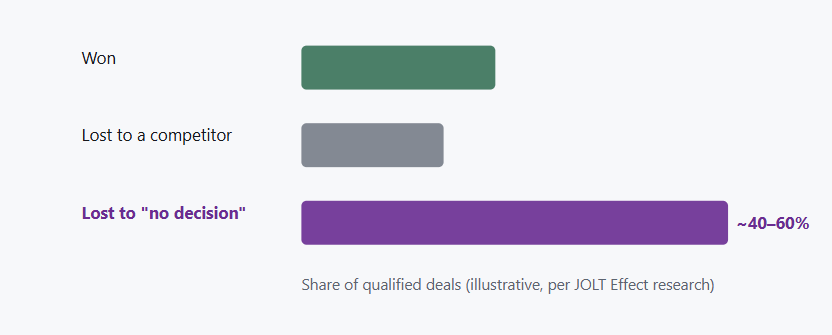
What it shows: the biggest bar isn't a rival — it's inaction. Most win/loss processes scrutinize the middle bar and barely examine the largest one, because "they didn't buy anything" doesn't feel like a competitive loss. It is.
Two ways a customer chooses nothing
"No decision" isn't one behavior. It's two, and they have opposite causes — which is exactly why a single sales reflex fails against both.
The first is status quo bias: the customer doesn't see the problem as urgent enough to act. They know there's an issue, but they've underestimated what it's costing them to live with it, so doing nothing feels cheap and safe. Roughly 44% of no-decision losses look like this.
The second is indecision: the customer is convinced they have a problem and even wants your solution — but they're paralyzed by the fear of making the wrong choice. Too many options, too much information, too much personal risk if the purchase goes badly. This is the larger share, around 56%, and it's the one most sales playbooks make worse.
Why "create urgency" backfires
Here's the contrarian finding that should change how you sell. The standard cure for a stalling deal is to turn up the pressure: amplify the cost of inaction, manufacture urgency, intensify the fear of missing out. Against a status-quo buyer who's underestimating their problem, some of that helps. Against an indecisive buyer — the majority — it actively backfires. Piling on urgency and consequences to someone already frozen by the fear of getting it wrong doesn't unstick them. It raises the stakes of a decision they're already terrified to make, and they retreat further into doing nothing.
You can't push an indecisive buyer over the line by making the line scarier. The thing keeping them from buying isn't insufficient fear of staying. It's too much fear of choosing.
This is why high-pressure tactics produce so many "ghosted" deals that looked hot a week ago. The rep did everything the playbook said — built urgency, drove ROI, pushed for the close — and pushed a frightened buyer straight into the safest available choice, which is always to wait.
Visual 2 — Two opponents, opposite plays
| Status quo bias (~44%) | Indecision (~56%) |
|---|---|---|
What's really happening | Doesn't see the problem as urgent | Wants to act but fears choosing wrong |
Looks like | "We're fine for now" | "Send more info / let me loop in others" |
Urgency tactics… | Can help — show the cost of staying | Backfire — raise the stakes, deepen the freeze |
What actually works | Quantify the cost of inaction | De-risk: narrow options, make a recommendation, lower the cost of being wrong |
The key move: diagnose which "no decision" you're facing before you respond. The same pressure that rescues a status-quo deal kills an indecisive one.
What this means for leaders
Re-orient your go-to-market around the right opponent. If half your losses are to inaction, a war room built entirely around competitors is fighting the smaller battle. Your messaging, your sales process, and your win/loss reviews should treat "the customer did nothing" as the primary failure mode to engineer against — because it is.
Track no-decision as its own loss category and study it like a competitor. Most CRMs bury these in "closed-lost" or "no response," which makes the biggest leak in the funnel invisible. Name it, size it, and review it deal by deal: was this status quo or indecision, and what did we do that made it worse? You can't fix the largest source of lost revenue if your system doesn't even record it as a loss.
And retrain the instinct to push. For the majority of stalled deals, the job isn't to make staying scarier — it's to make choosing safer. Narrow the options, give a clear recommendation instead of a menu, offer a smaller first step, and reduce the buyer's personal risk of being blamed if it goes wrong. The companies that win the next few years won't be the ones with the sharpest battle cards against rivals. They'll be the ones that made it genuinely easy for an anxious buyer to say yes.
Data drawn from: Dixon & McKenna, "Stop Losing Sales to Customer Indecision," HBR (2022), Challenger, "The JOLT Effect", and Ecosystems, "The True Cost of Doing Nothing."