


When customers leave, companies reach for a CS playbook — more check-ins, better onboarding, a save team. But most churn is decided long before renewal, by choices made in product, pricing, and who you sold to.
A customer churns on a Tuesday in Q3. The renewal didn't close, the usage had been sliding for two quarters, and the email is polite: budget pressure, a reprioritization, nothing personal. The account team runs the post-mortem. Within a week there's a plan. More frequent check-ins for at-risk accounts. A tighter onboarding sequence. A dedicated save team with a retention bonus. The board nods. The number is owned.
Almost none of it will work, because the company is treating the wrong organ.
Churn arrives looking like a Customer Success problem. It shows up in CS dashboards, gets discussed in CS reviews, and lands on a CS leader's scorecard. So the reflex is to spend on CS: more headcount, better playbooks, smarter health scores. Sometimes that buys a few points at the margin. But for most companies, the customer who left was already lost before the CS team ever touched the account. The decision to churn got made upstream, in rooms CS doesn't sit in.
Churn is decided where CS doesn't sit
Renewal is when churn is discovered, not when it's decided. By the time a renewal date arrives, the verdict is mostly in. The customer either reached a state where leaving feels costly — workflows wired in, value obvious, switching painful — or they didn't. That state was determined months earlier by four upstream choices, and not one of them belongs to Customer Success.
Who you sold to was a go-to-market decision. Whether the product reaches habitual use is a product decision. Whether the price tracks the value delivered is a pricing decision. Whether the customer's expectations match reality is a marketing-and-positioning decision. CS inherits the consequences of all four and is then asked to fix them one call at a time, after the cement has set.
Visual 1 — Where churn is actually decided
Upstream cause | Where it lives | Why CS can't fix it |
|---|---|---|
Sold to the wrong customer | Sales & ICP definition | The mismatch is structural; no amount of nurturing makes a poor-fit account a good-fit one |
Product never reaches habit | Product & design | CS can drive adoption events, not the core value loop that makes use automatic |
Price misaligned to value | Pricing & packaging | Relationship work can't close a gap the customer recalculates at every renewal |
Positioning overpromised | Marketing & messaging | CS spends the relationship apologizing for a gap it didn't create and can't unsay |
How to read it: each row is a decision made before CS engages. Customer Success owns the outcome of all four and the levers for none. That's the structural trap.
Look at the four in turn. The wrong customer is the most expensive because it's invisible on the way in — it arrives as revenue, a signed logo, a closed quarter. But a customer bought for the wrong reason, or one whose underlying problem your product was never built to solve, will churn no matter how warmly it's managed. You can't onboard your way out of a bad fit.
A product that never becomes a habit is the second. Retention is, mechanically, a function of whether using the thing becomes automatic. If the core loop doesn't pull the user back without prompting, CS is left manufacturing engagement — webinars, nudges, quarterly business reviews that exist to simulate a stickiness the product itself failed to create. That's a tell, not a fix.
Pricing misaligned to value is the third and the quietest. When the price the customer pays drifts from the value they perceive, every renewal becomes a re-litigation. No relationship survives a contract the buyer recalculates each year and likes less. And a promise the product can't keep is the fourth: positioning that oversold sets a gap the customer feels on day thirty and remembers on renewal day, while CS spends the intervening months apologizing for a sentence marketing wrote.
What CS can and can't do
None of this is an argument against Customer Success. A good CS team is real leverage. It rescues fixable situations, surfaces problems early, deepens relationships with accounts that were a good fit to begin with, and turns satisfied customers into expanding ones. Within its lane, it compounds value.
The lane is the point. CS operates on the margin of a structure it didn't build. Where the underlying fit, product, price, and promise are sound, CS converts that soundness into loyalty and growth. Where they're broken, CS becomes a very expensive way of slowing an outcome that was already determined. The same team looks heroic in one company and helpless in another, and the difference usually has nothing to do with the team.
Visual 2 — The churn decided long before it's discovered
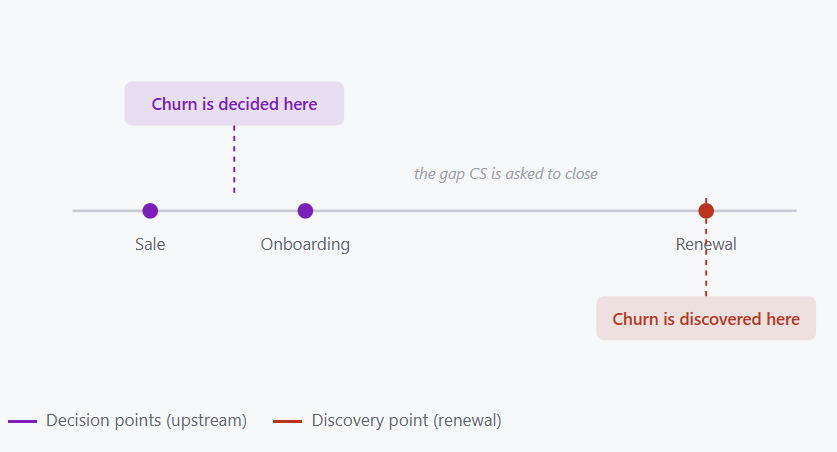
Conceptual timeline. The verdict is set at sale and onboarding. By the renewal date — where the loss is finally booked — the levers that mattered have long since locked.
How good CS hides the real problem
Here is the part that should worry the leadership teams who feel safest. A great CS team is not just unable to fix a strategy problem. For a while, it can hide one.
A talented save team can pull back accounts that were always going to wobble, smoothing the churn curve enough that the underlying defect never forces a reckoning. Net revenue retention holds. Logos stay. The dashboards look healthy, and the company concludes its retention is fine — when what it actually has is a structural leak being bailed out by hand, quarter after quarter, by people getting tired.
A great CS team is the most expensive thing you can buy to avoid finding out you have a strategy problem. It doesn't cure the leak. It bails fast enough that you stop hearing the water.
That masking is dangerous precisely because it feels like safety. The cost of the heroics is buried in CS payroll and effort, not in a churn number anyone is forced to explain. So the upstream causes go unexamined, the company keeps selling to the same wrong-fit accounts and shipping the same habit-less product, and the leak widens under the waterline. Then the save team scales past the point where heroics can keep up — a budget cut, a key departure, a quarter where the inbound slows — and the suppressed churn arrives all at once, compounded. The company that felt safest discovers it was the most exposed.
What this means for leaders
Stop treating retention as a CS scorecard line. If churn is decided upstream, then upstream owners — product, pricing, go-to-market — have to carry retention on their numbers too. A retention target that lives only in Customer Success is a target pointed at the one team that can't move the variables.
Read your CS team as a diagnostic, not just a defense. When your save team is working unusually hard to hold the number, that's not a sign to celebrate the team. It's a signal that something upstream is broken and being manually compensated for. Ask what they're rescuing accounts from, and you'll usually find the strategy problem.
Use retention as the truest test of product-market fit you have. Acquisition can be bought and growth can be borrowed, but retention is the market telling you, with its own money, whether what you built actually fits the customer you sold it to. When customers stay without being held, you have fit. When they only stay because someone keeps calling, you have a strategy problem wearing a CS costume — and the sooner you read it that way, the cheaper it is to fix.
A LookatBusiness original.