

It gets cut first in every downturn and credited last in every win. Yet brand may be the cheapest way left to lower what you pay to acquire a customer.
When budgets tighten, the brand line is the first to go. It's the easy cut: no campaign goes dark tomorrow, no dashboard turns red on Monday, and the case for keeping it always sounds soft next to a performance channel with a clean cost-per-lead. So it gets trimmed, then trimmed again, and the money moves to the channels that can prove themselves this quarter.
This is one of the most expensive reflexes in modern go-to-market, and it survives because of a measurement illusion. Brand and performance aren't two competing budgets. Brand is the thing that decides how much your performance budget costs.
The illusion that makes brand look expensive
Performance marketing looks cheap because it gets to claim every conversion it touches last. Brand looks expensive because it touches conversions first — and first touches don't show up in a last-click report. The buyer who already trusted your name clicks the same paid ad as the buyer who didn't, and the ad takes full credit for both. The work that made one of them cheap to convert is invisible to the system measuring it.
So the company "discovers" that performance is efficient and brand is not, defunds the thing quietly lowering its acquisition cost, and then watches that cost climb. The dashboard never flags the cause, because the dashboard was built to credit the channel that closes, not the one that warmed.
Brand doesn't compete with your paid channels for budget. It sets the price you pay in them. Cut it and every click you buy afterward costs more — you just won't see the line item.
Why the math got worse in 2026
This was always true. It's now urgent, because the cost of buying demand directly has been climbing on three fronts at once.
Paid channels keep inflating — more competition, higher clearing prices, diminishing returns on the same keywords. Signal loss from privacy changes has degraded the targeting and attribution that made performance feel surgical. And AI-mediated search is rewriting discovery itself: when an assistant answers the question instead of returning ten blue links, the brands that get named are the ones already known, not the ones with the highest bid. In all three, the company with existing demand for its name pays less or wins by default. That existing demand is brand.
The market sees it. Most B2B teams are raising marketing investment into 2026, and the smarter allocations are pushing a meaningful share — roughly a fifth to a third — back toward brand and reputation rather than pure capture. Not out of sentiment. Because capture-only got too expensive to lean on alone.
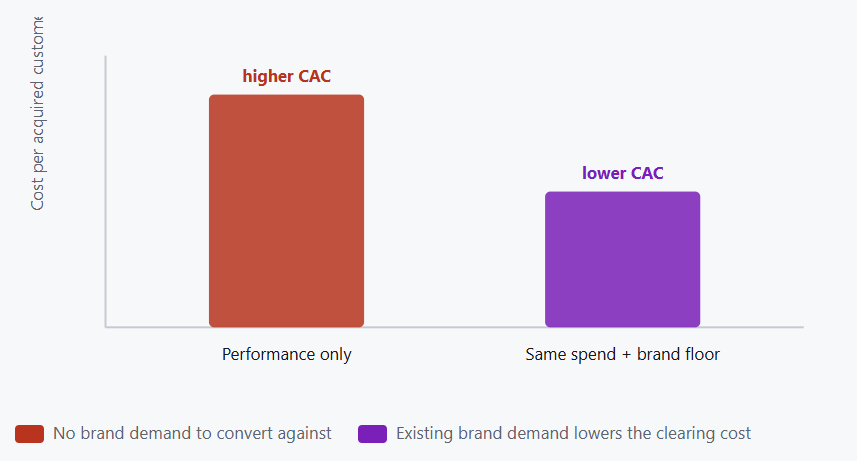
Visual 1 — Same performance spend, different CAC
|
Illustrative. The performance budget is identical in both. What differs is the demand it's converting against — and that's set upstream, by brand.
What brand is actually buying you
Strip away the awareness language and brand pays off in hard, acquisition-cost terms. Known names get higher click-through on the same ad, so you pay less per click. They convert warm traffic at higher rates, so you pay less per customer. They generate direct and branded search — demand that arrives without a media bill attached. They shorten sales cycles, because trust that already exists doesn't have to be manufactured deal by deal. And they support price, because a buyer who sought you out negotiates differently than one you interrupted.
None of those show up as a "brand conversion." All of them show up as performance looking unusually efficient — which is exactly why the credit lands in the wrong place and the budget follows the credit.
Visual 2 — Why the budget goes to the wrong line
What's really happening | What the dashboard reports | Resulting decision |
|---|---|---|
Brand warms the buyer | Paid ad gets last-click credit | Fund more paid, cut brand |
Known name lifts click-through | "Our ad creative is performing" | Credit the channel, not the name |
Branded search arrives free | Counted as cheap "organic" | Assumed permanent; under-invested |
Brand cut; CAC rises slowly | No single line turns red | Cause never identified |
The pattern: brand's contribution is systematically misattributed to the channels downstream of it. Measure on last-click and you will defund your cheapest demand and never know why CAC drifted up.
The honest counterpoint
This isn't a license to pour money into brand and wave away accountability — the "you can't measure it, so trust us" argument that gave brand budgets a bad name in the first place. Brand spend can absolutely be wasted, and a lot of it is: vanity campaigns, awards-bait, reach with no relevance to anyone who'd ever buy.
The real problem isn't that brand is unmeasurable. It's that brand and performance run on different clocks, and most companies judge both on the short one. Performance pays back in weeks; brand pays back over quarters, in lower CAC and shorter cycles you have to look for. Hold brand to performance's timeline and it always loses — not because it didn't work, but because you checked before it could.
What this means for leaders
Stop treating brand and performance as rival budgets and start treating brand as the input that prices the other one. The question isn't "brand or demand gen." It's "what is our acquisition cost going to be in a year, and what upstream demand is keeping it down."
Measure brand on its own clock and against the right metric — the trend in blended CAC, the share of pipeline that arrives already knowing you, the rate of branded search — not against a last-click report it was never going to win. If you only own one number, watch blended CAC over time. When brand is working, it's the line quietly bending down while everyone credits the paid channels.
And protect a brand floor through the cuts, especially the cuts. The instinct to defund it in a tight year is the instinct to make next year's customers more expensive at the exact moment you can least afford it. In an environment where buying demand keeps getting pricier, the cheapest demand is the demand you've already earned. That's not a soft asset. It's a discount on every click you'll ever buy.
Context drawn from: Directive, B2B Marketing Budget Benchmarks 2026, Data-Mania, B2B Marketing Budget Benchmarks 2026, and The Insight Collective, "B2B Performance Marketing in 2026."