


The price of capital just stepped up for good. At the same time, the price of intelligence is falling through the floor. Both are permanent, and the second will reshape more business models than the first.
Two of the most important input prices in the economy are moving in opposite directions at once. The cost of money has risen to a structurally higher plateau and looks set to stay there. The cost of cognition — applied intelligence, the thing knowledge work runs on — is collapsing at a rate with almost no historical precedent. Leaders are spending enormous energy adapting to the first. The second is the one that will quietly rewrite which businesses are worth building.
The numbers are hard to overstate. Running a frontier-class model cost on the order of $20 per million tokens in late 2022. By early 2026, equivalent performance runs near $0.40 — roughly a thousand-fold drop in a little over three years. One widely cited model fell 99.7% in price across the same span. This isn't a discount cycle. It's a sustained, order-of-magnitude repricing of a fundamental input, and the curve is still bending down.
Visual 1 — A thousand-fold collapse in three years
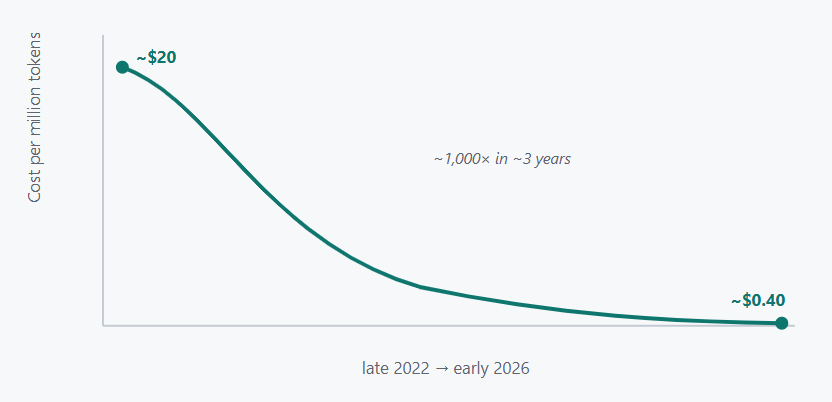
Illustrative, based on reported frontier-model pricing. When a core input falls this far this fast, the effect isn't "things get a bit cheaper." It's that the entire economics of anything built on that input get rewritten.
The rule that decides who wins
When an input price collapses, there's a reliable economic consequence, and it's not the obvious one. Cheap doesn't mean worthless-to-everyone — it means value migrates. It moves away from the thing that just got abundant and toward whatever is still scarce and necessary to make use of it. The complement appreciates as the input depreciates.
We've seen this movie with other inputs. When computing got cheap, hardware margins thinned and the value moved up to software and networks. When bandwidth got cheap, the pipes commoditized and the value moved to what flowed through them. Cheap cognition will follow the same logic: the intelligence itself becomes a low-margin utility, and the money moves to whatever you still need in order to turn intelligence into outcomes.
The winners of cheap intelligence won't be the companies with the most AI. Abundance commoditizes itself. The winners will own the scarce thing that cheap intelligence makes more valuable, not the cheap thing itself.
There's a tell already visible in enterprise budgets: even as the unit price of intelligence falls through the floor, total spend on it is rising sharply, because cheap cognition gets used in vastly greater volume. That's the signature of a true input collapse — consumption explodes faster than price drops. Intelligence is becoming both nearly free per unit and a bigger line item overall, which is precisely what happened to every input that ever got cheap enough to use everywhere.
What gets commoditized, what appreciates
If you accept that value migrates to the scarce complement, the strategic map gets clearer. Anything whose entire value proposition was "access to intelligence or expertise you didn't have" is on the wrong side of this. Anything that is the scarce thing required to deploy intelligence is on the right side.
Visual 2 — Which side of the collapse are you on?
Depreciates (cheap intelligence commoditizes it) | Appreciates (scarce complement to cheap intelligence) |
|---|---|
Selling access to expertise or analysis | Judgment about which answer to trust and act on |
Generic content and routine knowledge work | Taste, brand, and a point of view people seek out |
"We have the AI" as the moat | Proprietary data and real-world distribution |
Being the smartest answer in the room | Accountability — someone who owns the outcome |
The strategic question: not "how do we use AI," but "is our value the intelligence itself — now racing to zero — or the scarce thing that turns intelligence into a result someone will pay for?"
The trap dressed as the opportunity
The dangerous misread here is the most popular one: that cheap intelligence is an automatic windfall for any company that's "AI-native." It isn't. A capability that's collapsing in price toward zero is, by definition, a weak place to plant a moat. If your advantage is that you have access to powerful models, your advantage has an expiry date stamped on it by the same curve that's making the models cheap — because your competitor will have the same access next quarter, cheaper.
This is the uncomfortable symmetry with the cost of capital. In the cheap-money years, financial cleverness could substitute for operational quality, and when money repriced, the advantage snapped back to the operators. Cheap intelligence does something parallel: it removes "having the smart capability" as a durable edge and hands the advantage to whoever owns the scarce complements — the data, the distribution, the trust, the judgment to know what to do with an answer. The technology becomes table stakes. The moat moves to the boring, hard-to-copy things it was always built on.
What this means for leaders
Audit your business for value that's about to be commoditized. Anywhere you make money primarily by providing intelligence, analysis, or expertise that a cheap model can now approximate, assume that margin is under structural threat — not from a competitor, but from the input price itself. The question isn't whether it erodes. It's how fast, and what you're building to replace it.
Invest in the scarce complements, not the cheap capability. Proprietary data nobody else has, distribution that's hard to replicate, a brand people trust, and the human judgment to deploy intelligence well — these appreciate as cognition gets cheap. Pouring resources into "having the best AI" is buying the input that's racing to zero. Owning what makes that input useful is buying the thing that holds value.
And resist the instinct to treat this as purely a technology decision. The cost of cognition collapsing is a macro event on the scale of a major input repricing — closer to what cheap energy or cheap capital did to whole economies than to a software upgrade. The leaders who navigate it won't be the ones who adopted AI fastest. They'll be the ones who understood, early, that when intelligence becomes abundant, the prize goes to whoever owns what stays scarce.
Data drawn from: Andreessen Horowitz, "LLMflation", Epoch AI, LLM Inference Price Trends, and reporting on 2026 inference economics. Companion piece: "Cheap Money Was a Business Model."