


It's the fastest path to profit you own — no new customers, no cost cuts, no new product. Most companies set price once, by reflex, and never touch it again. That timidity has a price of its own.
Watch where a leadership team spends its attention. Cost gets hours — vendor renegotiations, headcount reviews, efficiency programs. Growth gets the rest — pipeline, campaigns, new markets. Pricing gets a meeting a year, if that, usually a cost-plus nudge or a "let's match the competitor" shrug. For the single most powerful profit lever a company controls, that's a stunning misallocation of executive attention.
The reason isn't ignorance. It's fear. Changing price feels dangerous in a way that cutting a vendor doesn't — you might lose customers, you might trigger a confrontation, you might be wrong in public. So price gets set once, defended forever, and quietly left to erode. The profit you forgo by under-managing it out of fear is what I'll call the pricing timidity tax — and most companies pay it every single month without seeing the line item.
The leverage you're ignoring
Here's the mechanics, because they're more dramatic than people expect. Price drops almost entirely to the bottom line. When you raise price, there's no added cost to produce the unit, no acquisition spend, no fulfillment — the increase is nearly pure profit. Compare that to the other levers: winning more volume costs you acquisition and delivery; cutting cost takes time and hits a floor. A modest price improvement and an equal-sized volume win are not remotely equal in profit terms, because one carries cost and the other doesn't.
Run it on a typical business with healthy-but-not-fat margins, and a small percentage improvement in price produces a far larger percentage improvement in operating profit than the same improvement in volume or cost. The exact multiple depends on your margins, but the direction is universal: price is the highest-leverage number on your P&L, and it's the one getting the least management.
Visual 1 — Same 1% improvement, very different profit
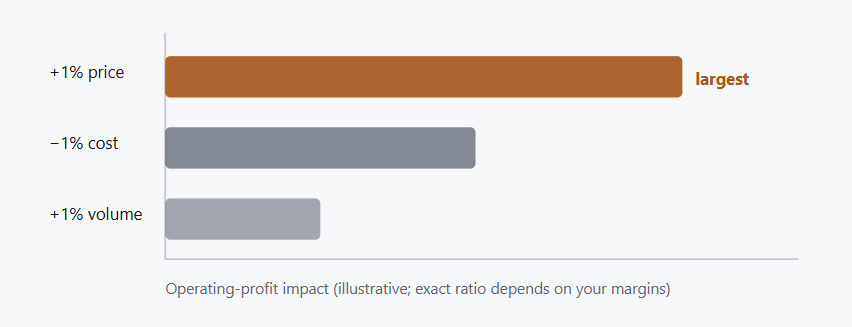
Why price wins: a price increase carries no extra cost, so nearly all of it is profit. A volume increase has to cover the cost of serving it; a cost cut hits a floor. Same headline percentage, very different bottom line — and price gets the least attention of the three.
Why a lever this powerful goes untouched
If pricing is this potent, the neglect needs explaining. Three things keep the lever stuck.
It's nobody's job. Cost has a CFO, growth has a CRO, product has a head — pricing usually has no owner, so it defaults to whoever set it at launch and never gets revisited. It's emotionally loaded: raising price means risking a customer reaction you can feel personally, while leaving it alone feels safe even when it's quietly costing you. And it's invisible to fail at. Set price too low and nothing breaks — you just make less than you could have, forever, with no alarm that ever rings. Under-pricing is the most comfortable expensive mistake in business.
Visual 2 — Where the timidity tax hides
Symptom | What it really means | The tax you're paying |
|---|---|---|
Same price for years | Value delivered has grown; price hasn't | A widening gap between worth and price |
One price for all customers | No segmentation by value or willingness to pay | Over-serving some, under-charging others |
Reflexive discounting to close | Sales buys deals with margin | Profit given away to soothe rep anxiety |
Cost-plus pricing | Price tied to your costs, not customer value | Leaving the value premium on the table |
How to use it: each row is a place the timidity tax accrues silently. None of them trip an alarm — which is exactly why they persist for years.
The risk you fear is smaller than the one you can't see
The case against touching price is always about risk: customers will churn, competitors will pounce, the market will revolt. Those risks are real but routinely overestimated — especially for value buyers, who care far more about whether the product works than whether it costs a few percent more. The risk that never gets weighed is the invisible one: the compounding profit you forgo every month you under-price out of caution.
The downside of a price increase is visible, immediate, and usually survivable. The downside of chronic under-pricing is invisible, permanent, and far larger. Companies obsess over the first and never measure the second.
This matters more in 2026 than it did in the cheap-growth years. With margins under pressure and capital expensive, profit you can capture from your existing base — without spending to acquire anyone — is the most efficient money in the building. Pricing is where that money lives, and timidity is what's keeping it locked up.
What this means for leaders
Give pricing an owner and a cadence. The lever stays stuck because no one is accountable for it and it's reviewed by accident. Assign it to a real person, and put it on the calendar at least as often as you review cost. A number this powerful should not be the only one on the P&L that nobody manages.
Price to value, not to cost — and segment. Cost-plus is the timid default; it caps your price at your expenses and ignores what the customer actually gets. Different customers derive different value and will pay accordingly. A single take-it-or-leave-it price almost always means you're under-charging the segment that values you most.
And test instead of agonizing. The reason pricing feels terrifying is that teams treat it as one irreversible, company-wide bet. It doesn't have to be. Raise prices for new customers, run it in one segment, pilot a tier. The fear that keeps the lever frozen dissolves the moment you make the change small, measurable, and reversible — and what you'll usually learn is that you could have moved years ago.
A LookatBusiness original. The profit-leverage relationship between price, volume, and cost is a long-established finding in pricing strategy; figures here are illustrative and vary with a company's specific margin structure.